
Search toggle

ANA Education Resources: Code of Ethics Toolkit

ANA Education Resources: Code of Ethics Toolkit

The ANA Education Resources: Code of Ethics Toolkit is a comprehensive, digital resource designed to help nursing faculty and educators weave ethics education into existing curricula as well as teach the 2025 Code of Ethics for Nurses (Code) across academic, clinical, hospital, and community settings with confidence.

Grounded in the Code of Ethics for Nurses (Code), this toolkit includes:

  • Core ethics knowledge on the Code, ethics principles, moral distress, decision-making, and professional obligations.
  • Educator preparation resources to build ethics teaching confidence and classroom-ready activities.
  • Flexible teaching pathways tailored to different experience levels and specialty practice areas.
  • Assessment and evaluation tools, including rubrics, reflection guides, and case study facilitation resources.

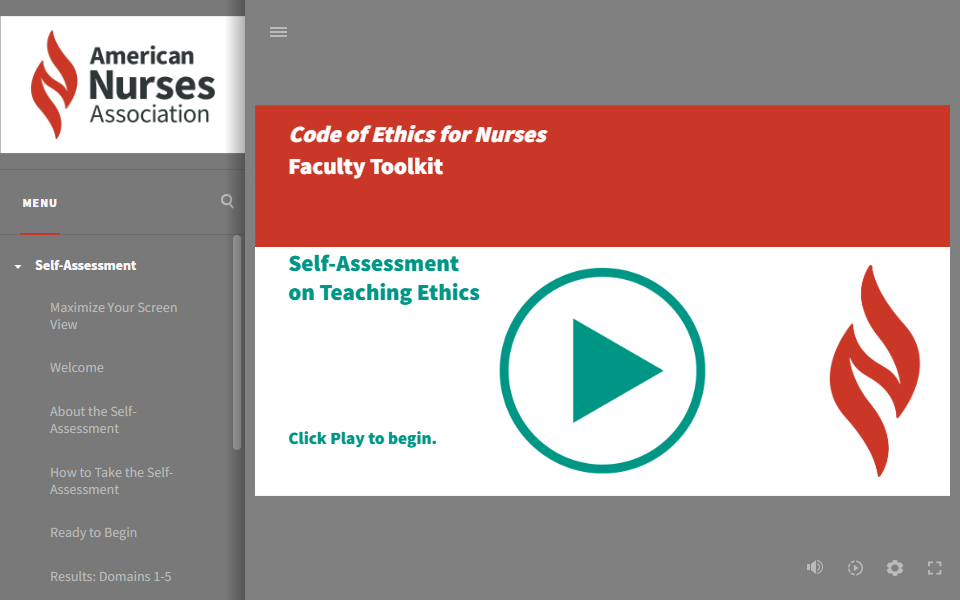
As you work with students to establish and strengthen their moral courage, you can do the same for yourself in improving your own nursing ethics education facilitation. An important first step is obtaining a baseline of your current levels of proficiency.

The self-assessment tool is meant to capture where you fall on the ethics teaching continuum so you have a map to improving your techniques. Even small changes can help you feel more confident, guiding your incorporation of nursing ethics training in your already-existing curriculum. Even if you are a seasoned expert at teaching ethics to your nursing students, you will find this self-reflective module beneficial before going further.

Start with the guide and quiz.
COE-Toolkit-preview

ANA Education Resources: Code of Ethics Toolkit

Your students need you to teach the new Code. Here is everything you need to do it.

The Code of Ethics Toolkit is the only resource built specifically to help nurse educators teach the ANA Code of Ethics for Nurses — from the first session to the most advanced seminar. Designed around the most significant revision to the Code in a decade, this toolkit equips educators with everything they need to bring the Code to life in the classroom.

Get the Toolkit      See what’s inside

Built for every educator

4

pathways designed for educators at every stage of their ethics teaching journey

20+ modules across all pathways

8 clinical specialties covered in Pathway C

100% aligned with the 2025 Code of Ethics

Code of Ethics Toolkit

Your students need you to teach the new Code. Here is everything you need to do it.

The 2025 ANA Code of Ethics for Nurses is the most significant revision in a decade. The Code of Ethics Toolkit is the only resource built specifically to help nurse educators teach it — from the first session to the most advanced seminar.

Get the Toolkit    See what’s inside

Built for every educator

4

pathways designed for educators at every stage of their ethics teaching journey

20+ modules across all pathways

8 clinical specialties covered in Pathway C

100% aligned with the 2025 Code of Ethics

Most nursing educators have not yet updated their ethics curriculum for the 2025 Code.
The language changed. The standards changed. The global obligations are entirely new. The Code of Ethics Toolkit makes the transition manageable — and the teaching better.

Who this is for

Four pathways. Find yours. Start where you are.

Core Modules

Ethics Basics

New to nursing ethics — or looking for a solid foundation before going deeper? The Core Modules introduce the essential ethical concepts, frameworks, and professional obligations every nurse educator needs to understand before teaching them.

— Foundational ethics concepts and frameworks

— Introduction to the ANA Code of Ethics

— Ethics in everyday nursing practice

— Preparing educators to teach ethics with confidence

Pathway A

New to Teaching Ethics

You know your specialty. You want to teach ethics well and do not yet have a reliable framework for doing it. Pathway A builds that foundation — the learning environment, the assessment tools, the difficult conversations.

— How to build an ethics-ready classroom

— Assessment tools and rubrics for ethical reasoning

— Navigating hot topics: EOL, AI, health equity, incivility

— How to approach the Code as a teaching tool

Pathway B

Aligning Current Teaching with the Code

You teach ethics already. You need to update your curriculum for the 2025 Code and want to go provision by provision, with the language, the strategies, and the tools to do it right.

— All 10 provisions of the 2025 Code with key language shifts

— Video lectures, teaching strategies, and classroom tools

— Updated rubrics using 2025 standards

Pathway C

Applied Ethics in Your Specialty

You teach a clinical specialty and want the ethics that live inside it — not a generic overview, but the specific tensions and obligations of your practice area. Select your specialty and go straight to what matters.

— Medical Surgical

— Maternal Child Health

— Psychiatric Mental Health

— Community and Public Health

— AND MORE

Core Modules

Ethics Basics

New to nursing ethics — or looking for a solid foundation before going deeper? The Core Modules introduce the essential ethical concepts, frameworks, and professional obligations every nurse educator needs to understand before teaching them.

— Foundational ethics concepts and frameworks

— Introduction to the ANA Code of Ethics

— Ethics in everyday nursing practice

— Preparing educators to teach ethics with confidence

Pathway A

New to Teaching Ethics

You know your specialty. You want to teach ethics well and do not yet have a reliable framework for doing it. Pathway A builds that foundation — the learning environment, the assessment tools, the difficult conversations.

— How to build an ethics-ready classroom

— Assessment tools and rubrics for ethical reasoning

— Navigating hot topics: EOL, AI, health equity, incivility

— How to approach the Code as a teaching tool

Pathway B

Aligning Current Teaching with the Code

You teach ethics already. You need to update your curriculum for the 2025 Code and want to go provision by provision, with the language, the strategies, and the tools to do it right.

— All 10 provisions of the 2025 Code with key language shifts

— Video lectures, teaching strategies, and classroom tools

— Updated rubrics using 2025 standards

Pathway C

Applied Ethics in Your Specialty

You teach a clinical specialty and want the ethics that live inside it — not a generic overview, but the specific tensions and obligations of your practice area. Select your specialty and go straight to what matters.

— Medical Surgical

— Maternal Child Health

— Psychiatric Mental Health

— Community and Public Health

— AND MORE

Ethics Basics Core Modules

Ethics Basics Core Modules: For strengthening and building your own foundational knowledge about nursing ethics, this is a great place to begin. The Core Modules: Ethics Basics will solidify the basic principles of ethics and specifically, nursing ethics, so you are armed with essential knowledge needed for building a strong curricula for your students.

Includes five modules.

Pathway A

Pathway A New to Teaching Ethics: For those less experienced at incorporating the topic of nursing ethics into your curriculum, Pathway A provides practical guidance including how best to introduce nursing ethics, connecting lessons to the Code, and assessment tools.

Includes four modules.

Pathway B

Pathway B Code of Ethics Focus: Pathway B takes a deep dive into the Provisions of the Code of Ethics for Nurses, exploring relational features, use of case studies and modes of delivery for nurse educators looking to refine and polish ethics lessons in their existing curricula.

Includes three modules.

Pathway C

Pathway C Applied Ethics: For standard courses in specialized areas of practice—health assessment, med-surge, maternal-child health, mental health, community health, gerontology, pharmacology, and nursing leadership. Pathway C addresses commonalities and differences in each discipline as well as considerations unique for each area.

Includes eight modules.

Every module includes ready-to-use materials — designed for educators who need tools that work the day they arrive.

As you work with students to establish and strengthen their moral courage, you can do the same for yourself in improving your own nursing ethics education facilitation. An important first step is obtaining a baseline of your current levels of proficiency.

The self-assessment tool is meant to capture where you fall on the ethics teaching continuum so you have a map to improving your techniques. Even small changes can help you feel more confident, guiding your incorporation of nursing ethics training in your already-existing curriculum. Even if you are a seasoned expert at teaching ethics to your nursing students, you will find this self-reflective module beneficial before going further.

Start with the guide and quiz.
COE-Toolkit-preview

Instruction

Video lectures with full narration

Teaching strategies with student instructions

Classroom Tools

Case studies, scenarios, and simulation guides

Observation tools and structured worksheets

Assessment

Analytic and holistic rubrics

Ethics OSCE station designs

Reflection grading protocols

Discussion participation tools

,,

What we owe students is not a set of rigid rules — it is a capacity for thinking, a moral vocabulary, and the professional courage to use both.

ANA Center for Ethics and Human Rights